What Is Timkat? The Ethiopian Feast of Epiphany Explained
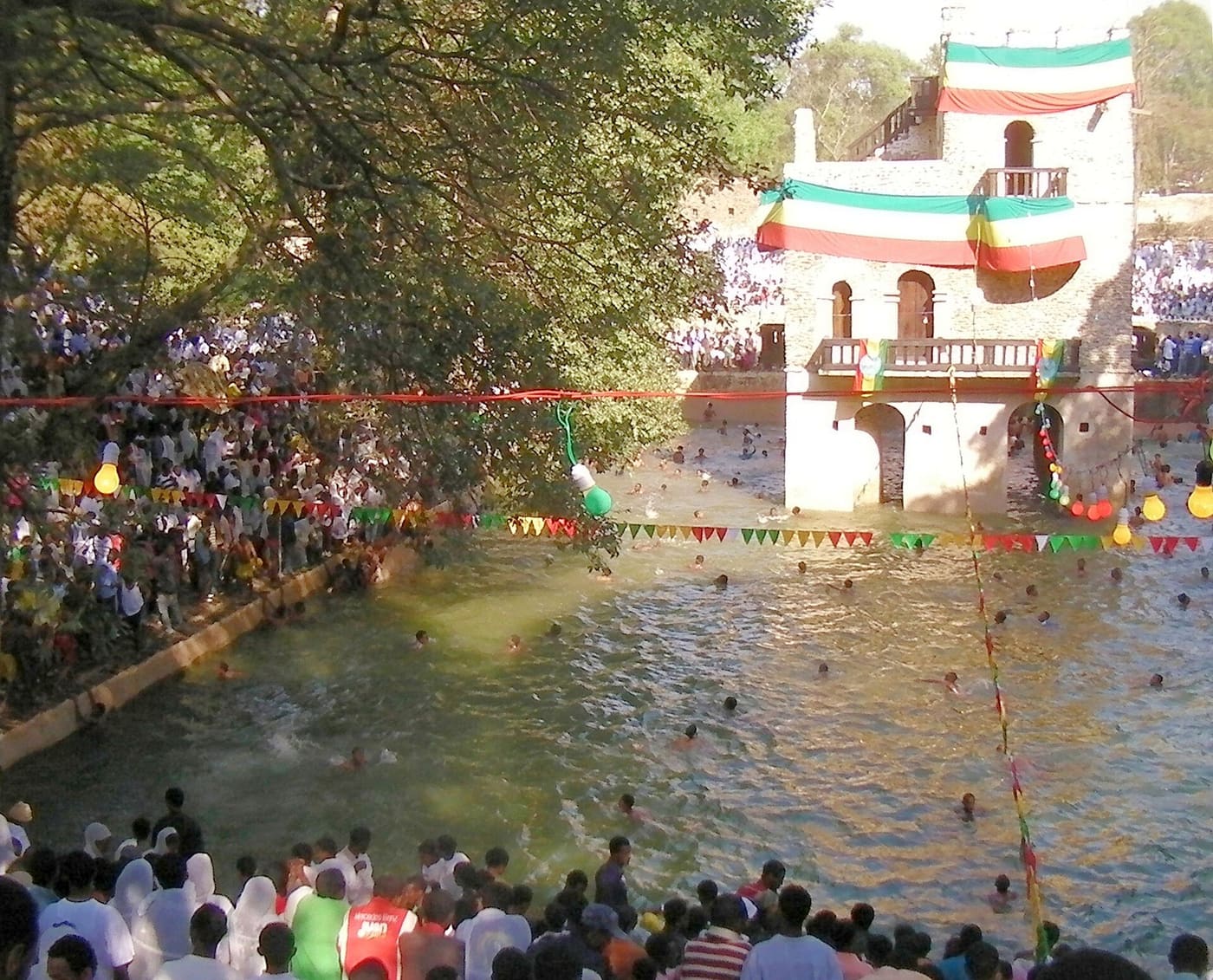
Timkat is the Ethiopian Orthodox Tewahedo Church's feast of Epiphany, which celebrates the Baptism of Jesus Christ in the River Jordan. It falls on Tir 11, usually January 19. On the eve, each church's tabot is carried in procession to a place of water, and the next morning the water is blessed and sprinkled on the faithful.
- Timkat celebrates the Baptism of Christ in the Jordan, when the Holy Trinity was revealed, which is why it is called Epiphany, meaning "manifestation".
- The feast falls on Tir 11 in the Ethiopian calendar, usually January 19 and in some years January 20.
- On the eve, called Ketera, the tabot of each church is carried in procession to a river, pool or prepared site, and the faithful keep vigil through the night.
- The blessing and sprinkling of water recalls Christ's baptism and the believer's own baptism; it is not a second baptism.
- Timkat is one of the Church's great public feasts, and UNESCO inscribed the Ethiopian celebration of Epiphany as intangible cultural heritage in 2019.
Timkat is the feast of Epiphany in the Ethiopian Orthodox Tewahedo Church. It celebrates the Baptism of Jesus Christ by John the Baptist in the River Jordan, and it falls on Tir 11 in the Ethiopian calendar, usually January 19. Its best-known sights are the procession of each church’s tabot to a place of water, an all-night vigil, and the blessing of the water the next morning.
For many Ethiopians, Timkat is the most joyful public feast of the year. This article explains what the feast commemorates, how it is kept over its two or three days, and why it should not be confused with the sacrament of baptism.
What does the word Timkat mean?
Timkat (also spelled Timket or Timqet) means “baptism” in Ge’ez, the ancient liturgical language of the Church, and in Amharic. The same word is used for the sacrament by which a person enters the Church, which the library explains in its page on Holy Baptism (Timkat).
As the name of a feast, though, Timkat refers to one event: the day Christ Himself was baptized. In English it is usually called Epiphany, from a Greek word meaning “manifestation” or “appearing”.
What does Timkat celebrate?
The Gospels describe how Jesus came from Galilee to the Jordan to be baptized by John. As He came up out of the water, the heavens opened, the Spirit of God descended on Him like a dove, and a voice from heaven spoke. In the words of Matthew 3:17 (NKJV): “This is My beloved Son, in whom I am well pleased.” You can read the whole account in Matthew chapter 3.
The Church sees this moment as a revelation of the Holy Trinity: the Father speaks, the Son stands in the water, and the Holy Spirit descends. That is the “manifestation” the name Epiphany refers to. The feast also recalls that Christ, who had no sin, entered the water to sanctify it, and so opened the way for the baptism of believers.
In many Western churches, Epiphany on January 6 focuses mainly on the visit of the Magi. In the Ethiopian Church, as in other Eastern and Oriental Orthodox Churches, the focus of the feast is the Baptism of Christ.
When is Timkat?
Timkat falls on Tir 11, the eleventh day of the fifth month of the Ethiopian year. In the Gregorian calendar this is usually January 19. In some years, because of how the two calendars line up around leap years, it falls on January 20. The article on the Ethiopian calendar explains how the months correspond.
The celebration actually spans more than one day:
| Day | Ethiopian date | What happens |
|---|---|---|
| Ketera (the eve) | Tir 10 | Fast of the eve; the tabots are carried to the water; night vigil |
| Timkat | Tir 11 | Liturgy, blessing and sprinkling of water; most tabots return |
| The following day | Tir 12 | In many places, the tabot of St. Michael’s churches returns |
Ketera: the eve of the feast
The day before Timkat is called Ketera. It is also a day of fasting, known as Gahad, meaning “vigil” or “eve”. The fasting rules article describes how the Church keeps the eves of Christmas and Epiphany as strict one-day fasts.
On the afternoon of Ketera, the clergy bring the tabot out of each church. Priests carry it on their heads, wrapped in richly embroidered cloth so that it cannot be seen. Deacons, priests and the faithful accompany it with processional crosses, colourful liturgical umbrellas, incense, the church drum (kebero) and sacred chant. Crowds dressed in white walk alongside, singing and clapping.
The procession goes to a body of water. This may be a river, a lake, a spring or a pool, or an open area where water has been prepared for the feast. Tents or a temporary shelter are set up there to house the tabots, and in towns with many churches several processions arrive at the same site.
The night vigil
The faithful keep watch through the night with prayers and hymns. In many places the Divine Liturgy is celebrated during the night or in the early hours of the morning, close to where the tabots rest. Practice varies from place to place, and the details of timing are set by the local clergy.
Timkat morning: the blessing of the water
At dawn on Tir 11, the clergy pray over the water and bless it. Then the blessed water is sprinkled on the people. Where the site allows, some people go into the water themselves. The mood is one of great joy, and the sprinkling can be energetic.
It is important to be clear about what this means. The Church confesses, in the words of the Nicene Creed, one baptism for the remission of sins. A person is baptized once. The water of Timkat is a blessing that recalls Christ’s baptism and reminds believers of their own; it does not baptize anyone again. Anyone with a personal question about baptism should speak with their priest.
The tabot procession home
After the blessing, the tabots begin their return journey to their churches, again in solemn procession. This is often the most festive part of the feast. Young people and choirs sing and dance before the tabot, priests and deacons chant, and elders lead the way.
In many places not every tabot returns on Timkat itself. The tabot of churches dedicated to St. Michael the Archangel commonly returns on Tir 12, since the twelfth day of each month is the Church’s monthly commemoration of St. Michael. Customs differ between towns and parishes.
What is a tabot, and why is it at the centre of Timkat?
A tabot is a consecrated tablet kept in the innermost sanctuary of every Ethiopian Orthodox church. The Church understands it as representing the tablets of the Law and the Ark of the Covenant. A church is consecrated through its tabot, and the Divine Liturgy is celebrated on it. It is never shown to the laity, which is why it stays covered even in the procession.
Timkat is one of the few occasions in the year when the tabot leaves the church in public. The procession is often linked, in Ethiopian preaching, to the Ark going before the people of Israel. The library’s history of the Church gives wider background on how these traditions developed.
Where is Timkat celebrated?
Timkat is celebrated in every Ethiopian Orthodox parish, in Ethiopia and abroad, and the Eritrean Orthodox Church keeps the feast as well. A few places are especially well known:
- Gondar, where the pool known as Fasilides’ Bath, in the old royal city, is filled with water for the feast.
- Lalibela, where the procession sets out from the rock-hewn churches.
- Addis Ababa, where large processions gather at Jan Meda and other sites across the city.
In the diaspora, parishes adapt the feast to local conditions and weather. Where there is no suitable river or lake nearby, the tabot may be carried around the church and the water blessed on the grounds.
In 2019 UNESCO added the Ethiopian celebration of Epiphany to its Representative List of the Intangible Cultural Heritage of Humanity. For the Church, though, Timkat remains first of all a religious feast: a day of prayer, fasting before it, and thanksgiving for the revelation of God at the Jordan.
Timkat and the sacrament of baptism: what is the difference?
Because they share a name, the feast and the sacrament are easy to confuse. The short version:
- The sacrament of baptism is received once. It is triple immersion in the name of the Father, the Son and the Holy Spirit, and it brings a person into the Church. It is the first of the seven sacraments.
- The feast of Timkat is celebrated every year by the whole Church. It commemorates the Baptism of Christ, blesses water, and renews in believers the memory of their own baptism.
The two are connected, since the Church teaches that Christ’s baptism sanctified the waters and gave baptism its meaning. But taking part in Timkat is not the same as being baptized.
Why Timkat matters
Timkat brings together several things at the heart of Ethiopian Orthodox faith: belief in the Holy Trinity, reverence for the tabot, the rhythm of fasting and feasting, and a strong sense of the Church as a community that walks together. Whole towns take part, and families often travel home for it.
For a newcomer, it is one of the clearest windows into how the Ethiopian Church lives its faith in public. For believers, it is a yearly return to the Jordan, where, as the Church proclaims, God revealed Himself as Father, Son and Holy Spirit.
For more on the Church’s teaching and history, the Encyclopaedia Britannica entry on the Ethiopian Orthodox Tewahedo Church offers a short outside overview.
Common questions
Is Timkat the same as being baptized?
No. The word Timkat means "baptism", and the library uses it for the sacrament as well, but the feast is a commemoration of Christ's own baptism. The Church confesses one baptism, received once. Being sprinkled with blessed water at the feast is a blessing and a reminder of that baptism, not a repetition of it. Questions about receiving the sacrament itself are best taken to a priest.
When is Timkat celebrated?
Timkat is kept on Tir 11 in the Ethiopian calendar. Because of the way the Ethiopian months line up with the Gregorian ones, that is usually January 19, and January 20 in the years when the calendars shift by a day. The eve, Ketera, falls the day before, and the celebrations often continue into the following day.
Can visitors attend Timkat?
Yes. Timkat is a public feast held largely outdoors, and visitors from abroad come to watch it in places such as Gondar, Lalibela and Addis Ababa. Respectful conduct matters, since it is a religious celebration and not a show. Modest dress, keeping a respectful distance from the tabot and the clergy, and asking before photographing people are all good practice.
Do Ethiopian Orthodox Christians outside Ethiopia celebrate Timkat?
Yes. Parishes in the diaspora keep the feast too, though the form depends on local conditions. Where a river or lake is close and the weather allows, a procession to the water may take place. Elsewhere the tabot may be carried around the church grounds and the water blessed at the church. The parish priest sets the local arrangements.
Sources
- The Ethiopian Orthodox Church, edited by Aymro Wondmagegnehu and Joachim Motovu (1970)
- Ethiopian Orthodox Tewahedo Church, Encyclopaedia Britannica
- Matthew 3, New King James Version, Bible Gateway
- Ethiopian epiphany, UNESCO Representative List of the Intangible Cultural Heritage of Humanity (2019)